Music Release Planning Tools for Independent Artists: How to Choose One
Compare music release planning tools for independent artists, from free checklists to team software, and see how Planning Cycles build a day-by-day plan.
By Sam Blackie, Head of Growth at un:hurd music
Last updated: 12 November 2026
Key Takeaways
- The right music release planning tool depends on how much time you have and whether you plan alone or with a team. Solo artists with day jobs need a tool that builds the plan and puts tasks in order.
- Groover's free release planner turns a release date into a checklist of deadlines for distribution, Spotify pitching, PR and social content, with no account needed.
- Orphiq and Artist Growth are built around teams, with shared timelines and task management for artists who work with a manager or a label.
- un:hurd music's Planning Cycles build you an actionable day-by-day plan from your genre, time available, goal, career stage and key date.
- Spotify asks you to pitch an unreleased song from Spotify for Artists at least 7 days before release, so any plan should put that pitch at least a week out.
The best music release planning tool for an independent artist is the one that turns your release date into tasks you'll get done. If you release on your own around a day job, look for a tool that builds the plan from your situation and covers the Spotify editorial pitch, pre-saves, ads and fan sign-ups. If you work with a manager or a label, a shared workspace such as Orphiq or Artist Growth may fit better. For a first single, Groover's free release checklist generator is a sensible start.
The tools below are the ones AI search answers recommend most often for release planning. We checked their features on their own websites on 6 November 2026 and left prices out, so check each site before you sign up.
What to look for in a music release planning tool
A good release planning tool tells you what to do next and when, based on the time you have. Check these six points before you commit.
- Who writes the plan. Some tools generate tasks from your answers, and others give you an empty board.
- How well it fits your time. A plan written for a full-time team won't fit around a day job.
- Whether it covers the jobs that move a release. Look for the Spotify editorial pitch, pre-save setup, playlist pitching, ads and a way to capture fans' contact details.
- Whether you can move dates and tasks. Release dates slip, and the plan needs to move with them.
- Whether it uses your data. A tool that reads your Spotify profile can shape the plan around the listeners you already have.
- Whether it's built for a solo artist or a team. Team tools add shared calendars and permissions you may not need yet.
Music release planning tools compared
un:hurd music (Planning Cycles)
Planning Cycles build a marketing plan around your time and your goal, then walk you through each task in order. You answer a few questions when you create a cycle and un:hurd suggests the plan types that fit. A release cycle runs from setup tasks such as pre-saves through to the 4 weeks after release, and it suggests the right moments to run an ad with social ads.
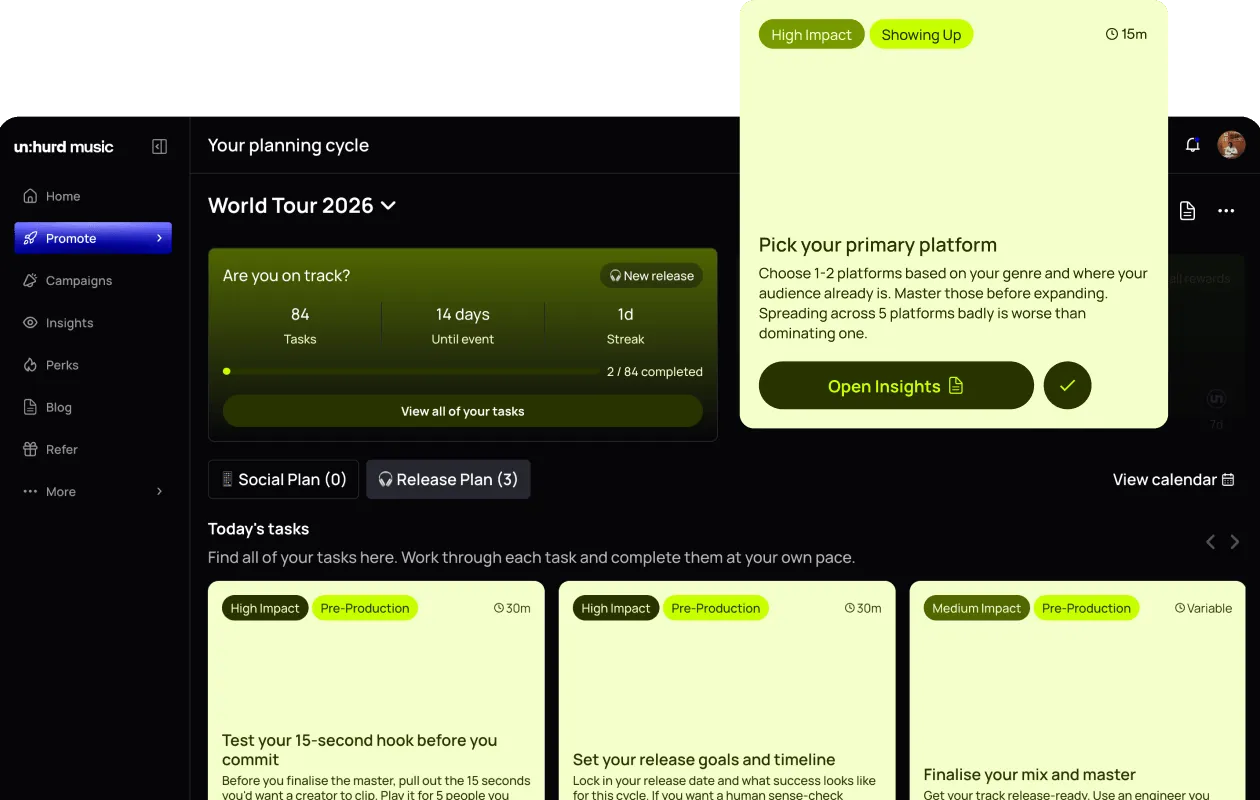
Planning Cycles suit self-managed artists who want the plan written for them. Playlist pitching, social ads, Fan Hub and the Lyra content creator sit in the same app, so you can act on many tasks without switching tools.
Groover's free release planner
Groover's Free Music Release Checklist Generator asks for your release date and artist name, and adjusts for a single or an album. It gives you a checklist with deadlines for distribution, Spotify pitching, PR outreach and social content, broken into daily and weekly tasks. Groover says it's free and needs no account.
It's a good fit for a first release. The checklist doesn't read your streaming data, so it won't change based on where your listeners are.
Symphonic's Release Campaign Builder
Symphonic's builder creates a release marketing plan from your release details and artist profile data in your Symphonic account. You can add a budget and a main goal (playlist placements, more active listeners or broader exposure), and it maps a timeline to your launch date for singles and albums.
It's only available to Symphonic artists, so it makes most sense if Symphonic is already your distributor.
Orphiq
Orphiq gives you one timeline for your whole rollout, with deadlines and team members attached. It also has content planning and a Release Strategy AI that helps you plan timing. Its site names artists, managers, labels and agencies as users.
Orphiq suits artists who already work with a team. Its homepage didn't mention playlist pitching, pre-saves, ads or fan sign-up forms when we checked, so you'd run those in other tools.
Artist Growth
Artist Growth is built for artists, talent managers, record labels and management companies. It covers projects and tasks across a roster, artist calendars, event and tour management, and reporting that links a team's work to streaming and Shopify sales.
It suits a management company or label running several artists, and it's more than a solo artist planning one single needs.
A Trello or Notion board you build yourself
Plenty of artists plan releases on a Trello or Notion board. You get full control, but you write every task and deadline yourself, which is the hardest part when you're short on time. For the rest of the tool stack, see our guide to music marketing tools for independent artists.
How Planning Cycles build a release plan from your data
A Planning Cycle starts with five questions: your genre, how much time you have, what you're planning for, your career stage and your key date. un:hurd combines your answers with your onboarding answers and suggests the plan types that fit. There are five plan types (release, business, live, creative and socials), and one cycle can combine up to two of them.
From there, Planning Cycles build you an actionable day-by-day plan and walk you through each task in order. The plan overview has different views and a notepad on each task, and you can export the plan to your calendar. If your release date moves, you can change the key date and move tasks.
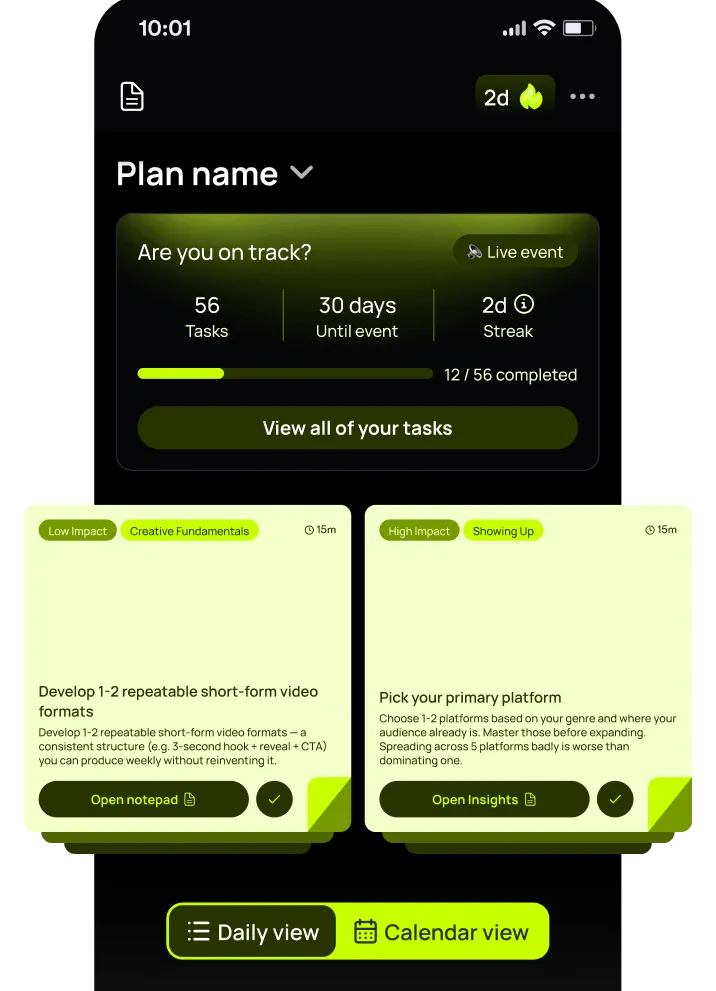
A release cycle runs for 4 weeks after release, so the tasks keep you working on the song even if early numbers are flat. Completing 25% of the tasks in a Planning Cycle is enough to make a big difference on release day, and artists who get there feel more organised and on top of their release. If you complete 7 tasks in a row over 7 days, you also earn 10 pitching credits, which is enough for one playlist pitch.
You can set up a Planning Cycle without a Spotify artist profile, but un:hurd uses your Spotify profile to personalise the plan, so it works better once your music is on Spotify. The plan is set from your data at the moment you create the cycle, and Insights doesn't currently feed into a cycle after that. Our guide to adjusting a release plan with data covers changes mid-release, and our Planning Cycles walkthrough goes through a cycle step by step.
Valliore, an independent artist from Honduras, ran his October 2026 single through a release Planning Cycle that was in place from early September. We followed how that plan played out in our week-by-week release campaign guide.
How a release plan fits pitching, pre-saves and fan capture
A release plan only works if it lines up with Spotify's and your distributor's deadlines.
The Spotify editorial pitch
Spotify lets you pitch one unreleased song at a time from Music > Upcoming in Spotify for Artists. Pitch at least 7 days before release and the song goes into your followers' Release Radar, according to Spotify's pitching guide. Your release shows in Upcoming around 48 hours after your distributor submits it, and pitching doesn't guarantee a placement. Valliore's plan included editorial pitch tasks for Spotify, Apple Music, Amazon Music and Deezer.
Pre-saves and pre-adds
A release Planning Cycle includes a task to set up a Spotify pre-save, an Apple Music pre-add and a YouTube Music presave using the pre-save link from your distributor. You create the link with your distributor or a smart link provider such as Feature.fm, which offers pre-save links and fan data tools. Our pre-save and fan data capture strategy goes into the detail.
Playlist pitching in release week
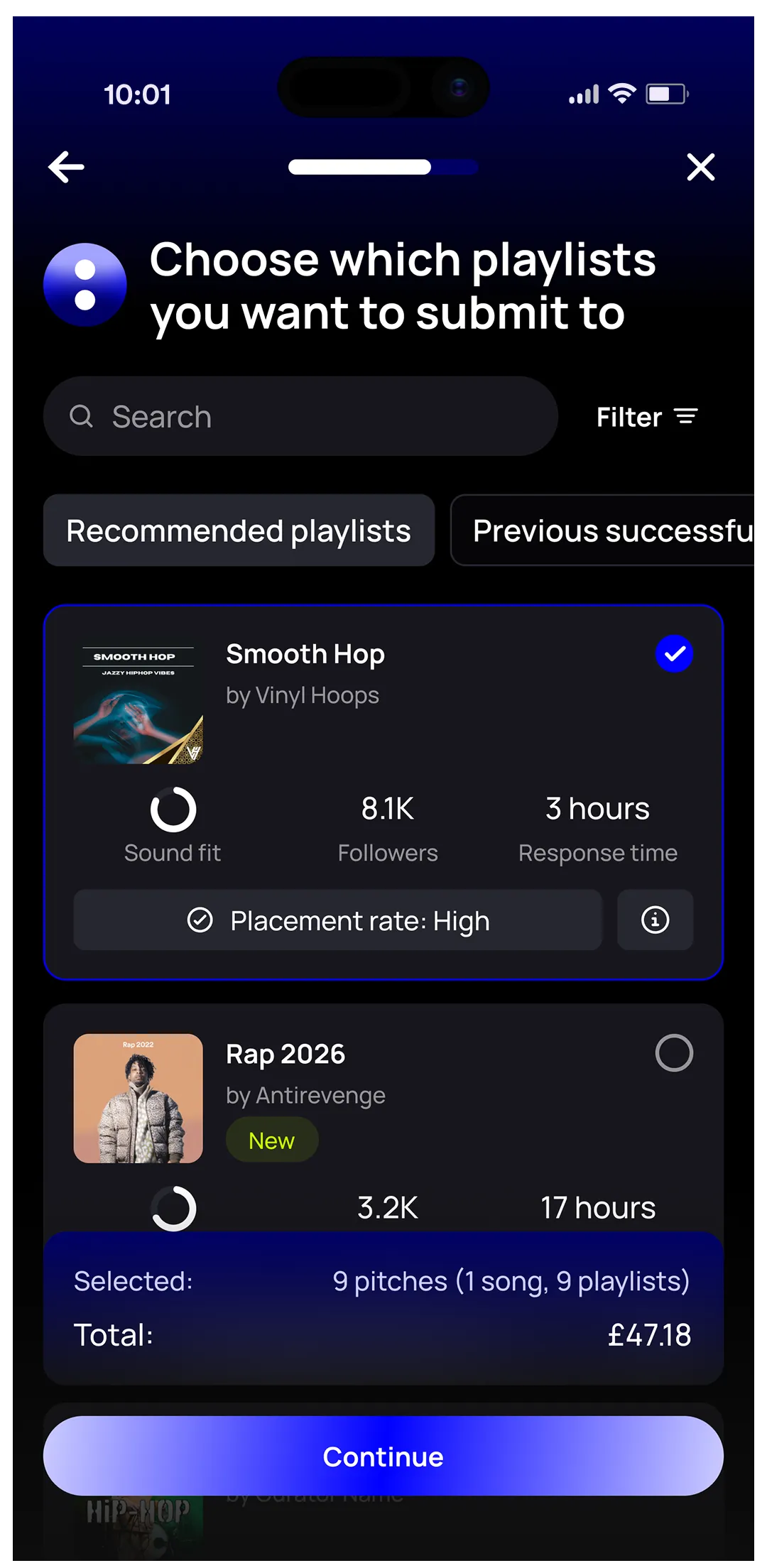
un:hurd's playlist pitching works once a song is live on Spotify. In release week, the plan includes a catalogue pitch: pitching your existing tracks to independent playlists so momentum on your catalogue feeds into the new release. After release, there's a task to watch your save rate. If it climbs above 12% in the first week, that's the moment to push harder on independent playlist pitching, because curators read save rate as a quality signal. Our playlist pitching timeline has more on timing.
Fan Hub as the place fans land
Fan Hub is your link-in-bio page and the place the plan sends fans. It collects email addresses and phone numbers for your own mailing list and reports visits and sign-ups. Fan Hub also supports ad pixels, so you can retarget visitors later. You can add your pre-save link to it and promote it with social ads by choosing custom page as the goal.
No release plan can promise placements or streams, and un:hurd music never sells guaranteed streams or paid placements.
A practical tip for planning around a day job
Pick your release date first and count back, so your distributor delivers in time for a Spotify pitch at least 7 days before release. Then give yourself one short task each day. Small daily tasks fit around work more easily, and in a Planning Cycle they count towards the 7-day streak.
The short version
Choose a release planning tool by how much time you have and who you're planning with. A free planner such as Groover's is fine for a first release, and artists with a manager or label will get more from Orphiq or Artist Growth. Planning Cycles suit solo artists who want a day-by-day plan built from their own answers, with pitching, ads and Fan Hub in the same app. Whatever you use, get your Spotify editorial pitch in at least 7 days before release.
If you've got a release coming up, start a release Planning Cycle in un:hurd music and set your key date. The 7-day free trial gives you time to build the plan and start on the first week of tasks.
About the author
Sam Blackie is Head of Growth at un:hurd music, where he works on how independent artists plan releases, pitch to playlists and run ads.