Playlist Pitching Timeline: When to Pitch Your New Release
Plan your playlist pitching timeline: pitch Spotify editors 7 days before release, then independent curators on release day. A week by week plan for new music.
.png)
By Sam Blackie, Head of Growth at un:hurd music
Last updated: 13 October 2026
Key Takeaways
- Pitch your new release to Spotify's editors in Spotify for Artists at least 7 days before release day. Pitching that early also lets you choose which song from the release goes into Release Radar, Spotify's Friday playlist of new music.
- Independent playlist curators run on a different clock from Spotify's editors. Plan who you'll target a few weeks before release, seed those curators about 14 days out, then pitch them as soon as the song is live.
- On un:hurd music, you can pitch a song once it's live on Spotify. Curators have 7 days to respond, they take around 48 hours on average, and if a curator doesn't respond in time the pitch is refunded.
- Judge a pitching campaign over the 4 weeks after it starts. Accepts and declines are only part of the picture, and un:hurd's pitch stats screen tracks how your Spotify monthly listeners and followers move across those 4 weeks.
The best time to pitch a new release depends on who you're pitching. Spotify asks for your editorial pitch at least 7 days before release, sent from the Upcoming section of Spotify for Artists. Independent playlist curators on un:hurd take pitches once the song is out, so the work before release is choosing and warming up the right curators, and the pitching itself happens in release week.
Lining up those two clocks gives a release its best chance of early momentum, and the timeline below shows how they fit together.
The playlist pitching timeline at a glance
This is how a single release lines up when you're pitching both Spotify's editors and independent curators. Use the 7-day editorial deadline as a hard floor and give yourself more room where you can.
- Three to four weeks before release: deliver the song to your distributor. Spotify needs 5 business days to get new music live, and the song shows up under Music > Upcoming in Spotify for Artists around 48 hours after your distributor submits it. Delivering early leaves time to write a proper pitch.
- A few weeks before release: plan which independent curators and playlists you'll target, using a similar song of yours that's already out as the reference.
- About 14 days before release: seed your curators, so the people you'll pitch already know a song is coming.
- At least 7 days before release: pitch Spotify's editors from Music > Upcoming in Spotify for Artists.
- Release day: the song goes live and lands in your followers' What's New feed. Pitch your independent curators as soon as the song is on Spotify.
- Days 1 to 7: curators respond. On un:hurd the average is around 48 hours, and every curator has 7 days.
- Weeks 1 to 4: watch what the placements do. Release Radar can keep your song in rotation for up to 4 weeks for listeners who haven't heard it yet, and un:hurd's pitch stats screen tracks your monthly listeners and followers over the same 4 weeks.
Alex Brees, founder of un:hurd, sums up the independent side: "Seed your curators 14 days before release. Look for curators who accept pitches organically on socials as well as the ones on un:hurd, then pitch as soon as your track is out and on un:hurd. We recommend five or more pitches to give your release week the best chance of momentum."
How pitching Spotify's editors works, and what a pitch can't do
You pitch Spotify's editors through Spotify for Artists, and Spotify asks you to deliver the music and send the pitch at least 7 days before release so editors have time to listen. You pitch from Music > Upcoming by choosing a song and filling in the pitch form. Spotify says more detail gives the song a better chance.
A few rules shape your timeline:
- You can pitch only one song at a time. Once that song is live, you can pitch the next one.
- You can't pitch anything already live, a compilation or a song where you're only the featured artist.
- You can edit a pitch up to release day, but there's no guarantee editors will see late changes.
- Editors might playlist a different song from the release than the one you pitched.
- A pitch doesn't guarantee a placement. Any results show under Music > Playlists once the song is live.
Spotify's editorial playlists are curated by genre, lifestyle and culture specialists. Spotify says services that sell guaranteed streams or playlist placements breach its terms and can get your music removed.
What to prepare before you pitch anyone
Before you pitch editors or curators, make sure the song and your profile are ready for someone hearing you for the first time.
- Have the pitch details to hand: genre, mood, instruments, the story behind the song and any marketing you have planned. The Spotify pitch form asks for this, and independent curators want the same context.
- Check your Spotify artist profile has a current photo, bio and your latest releases, so a curator who checks your profile finds you active.
- Pick the song from the release you want heard most. With Spotify you pitch one song at a time, and the pitched song is the one you choose for Release Radar.
- Read our guides to writing a pitch for editorial playlist placements and how to write your pitch for editorial playlist placements for the pitch text itself.
When to pitch independent playlist curators
Pitch independent curators as soon as your song is live on Spotify, and do the groundwork in the few weeks before. On un:hurd you can only pitch a song once it's on Spotify, so the pre-release window is for planning who to target.
A practical way to plan is to look at which curators and playlists suit a similar song you've already released. un:hurd recommends playlists for a track based on sound fit, which compares the sound and genre of your track with the playlist, and on how far the artists already on a playlist overlap with artists similar to you. There are 598 curators on un:hurd's playlist pitching, and you can see each curator's average response time before you pitch, which helps when release week is tight.
Look beyond one platform as well. Some curators take pitches directly on their socials, and seeding them around 14 days out means your pitch on release day isn't the first they've heard of you. Before you add any curator to your list, check their playlists are real. Our guide to evaluating Spotify playlist quality and our Spotify playlist safety guide cover what to look for.
How to use your data to choose playlists and judge your pitching results
un:hurd's Smart Insights can also tell you when an older song is worth pitching. It flags when a track's Spotify Popularity score is climbing and suggests pitching it to playlists.
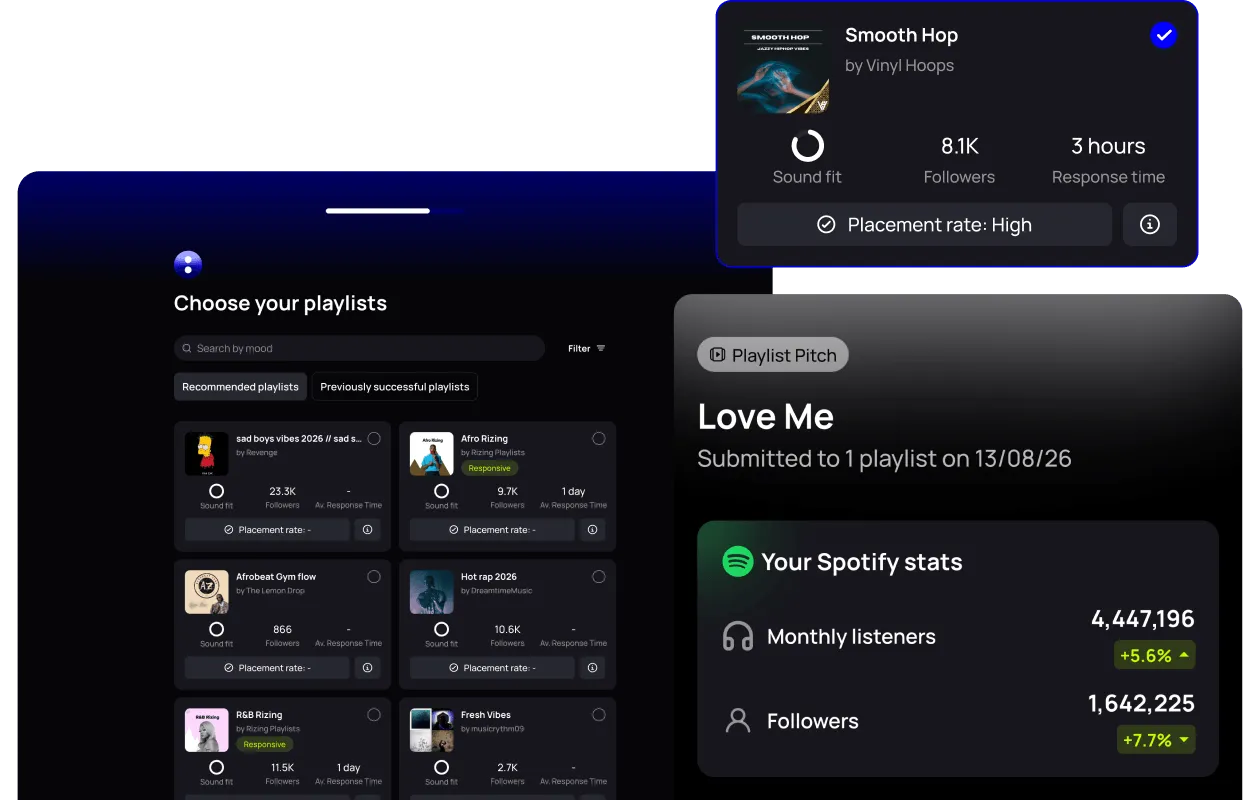
Once a pitch is out, curators on un:hurd have 7 days to respond. They respond in around 48 hours on average, though it varies by curator, and if a curator doesn't respond in time the pitch is refunded to you.
Expect more declines than accepts. Over the past month, curators on un:hurd accepted 717 pitches and declined 1,760, so roughly three in ten pitches that got an answer were accepted. Declines happen to everyone: when we pitched Justin Bieber's "YUKON" as an example campaign to show the pitch stats screen, curators declined it.
The placements that land can carry a lot of weight. George Bone pitched his track 'Til the world ends' with un:hurd, and the playlist Slow Dance brought in about a third of the song's streams.
To judge the whole campaign, look at the 4 weeks after it starts rather than the first day's replies. Each un:hurd pitch campaign has a stats screen showing how your Spotify monthly listeners and followers change over those 4 weeks. For a wider view of tracking, see our playlist pitching guide.
Whether paying for playlist pitching is worth it for a new artist
Paying for playlist pitching can be worth it for a new artist when you're paying for a curator's time to listen and the outcome is left to the curator. Paying for a guaranteed placement or a set number of streams is never worth it, because Spotify treats it as breaking its terms.
On un:hurd, each pitch is worth £6. The monthly membership (£12.99 a month) includes one pitch a month, and the annual membership (£69.99 a year) includes 12. If a curator doesn't respond within 7 days, you get the pitch back. With roughly three in ten answered pitches accepted, a handful of well-targeted pitches in release week gives you a better chance than a single one, which is why Alex recommends five or more. Our guide to playlist pitching costs and pricing compares the options.
The short version
Deliver your song to your distributor three to four weeks out, then pitch Spotify's editors from Spotify for Artists at least 7 days before release. Plan your independent curator list a few weeks ahead using a similar song, seed those curators about 14 days out and pitch them as soon as the song is live. Expect more declines than accepts, give curators their 7 days, and judge the campaign on what your listeners and followers do over the following 4 weeks.
If your release is out this week, start a playlist pitch in un:hurd and use the recommended playlists for your track. The monthly plan includes one £6 pitch a month.
About the author
Sam Blackie is Head of Growth at un:hurd music and has worked on artist ad strategy.