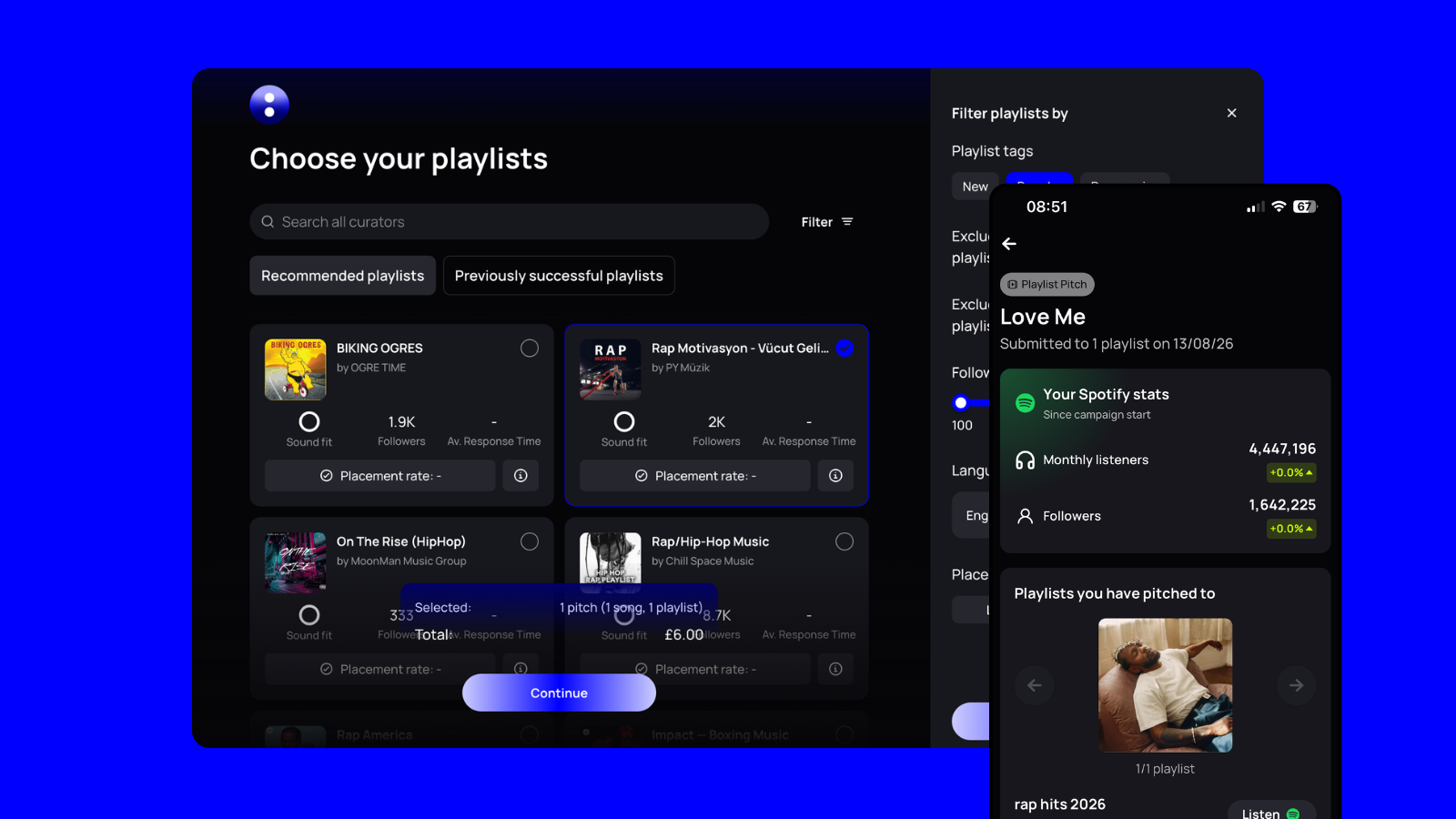
How Much Does Playlist Pitching Cost? Pricing Guide for Independent Artists
Compare playlist pitching costs, pricing models, campaign budgets, and hidden risks. See why un:hurd is the go-to choice for independent artists.

TL;DR
- Playlist pitching can cost a few pounds per submission or several hundred pounds for a managed campaign. The pricing model determines what your fee buys.
- un:hurd Pro costs £12.99 monthly with one included pitch, or £69.99 annually with 12 pitches. Pitches can also be bought from £5 each with bundled pricing.
- un:hurd suits time-poor independent artists because listener-overlap matching reduces manual playlist research. Pro also includes release-planning and advertising tools.
- Price alone tells you little. Compare relevant matches, completed reviews, feedback rules, and credit policies.
- Guaranteed placement is a red flag. Legitimate services charge for pitching work or consideration, while curators retain the final decision.
What playlist pitching actually costs right now
Based on the public prices linked below, entry prices range from €2 for one Groover contact to $280 for a Playlist Push campaign. SoundCampaign starts at $80, while un:hurd Pro costs £12.99 monthly or £69.99 annually. The providers also sell different levels of access, review, targeting, and campaign management, so their entry prices are not directly comparable.
Groover charges €2 including VAT for a standard contact, with a €10 minimum top-up. Some contacts cost €4 to €6. SubmitHub sells credit bundles. Bundle prices and credit quantities can change, so check its live packages page when planning a campaign. Individual curators can charge up to four credits. SoundCampaign’s calculator accepts budgets between $80 and $5,000, while Playlist Push campaigns start at $280.
Each provider charges for a different service. Groover sells access to a chosen contact and written feedback. SubmitHub credits fund submissions under curator-specific rules. SoundCampaign charges for completed reviews, while Playlist Push distributes a track through a managed campaign. un:hurd includes one monthly pitch for £12.99 or 12 annual pitches for £69.99, alongside listener-overlap matching and release tools. Its lower upfront commitment suits artists who want help finding relevant opportunities without funding a larger campaign. None of these fees guarantees placement, streams, or a financial return.
The four pricing models artists actually pay for
Pay-per-contact pricing gives you direct control over who receives your track. Groover charges for each selected contact, and it returns credits when that contact misses the seven-day response window. You can test a small list, but you must research every recipient yourself. A valid rejection still uses the fee.
Credit systems separate the amount you deposit from the cost of each submission. SubmitHub curators can charge different numbers of credits, so 100 credits do not necessarily buy 100 submissions. You control recipient selection and spending, but curator tiers and submission rules make the final outreach count variable.
A low submission price does not show that a curator is more likely to accept your track or reach an engaged audience. The providers do not publish comparable acceptance or engagement data that would support that conclusion.
Managed campaign budgets trade some control for less administration. Playlist Push calculates a campaign around eligible curators and targeting choices. SoundCampaign lets you set a wider budget and pays curators for completed reviews. Both coordinate distribution, but neither sells guaranteed placement. Their higher entry costs suit artists ready to fund a broader campaign rather than a small test.
Subscription-plus-credits pricing spreads pitching costs across your release schedule. un:hurd Pro includes pitching credits within a monthly or annual membership, alongside matching and release-planning tools. Listener-overlap matching reduces the manual work of finding relevant opportunities, which can make the model more practical when you balance music with a day job. The subscription makes most sense when you use the wider toolkit or release regularly, while occasional users may prefer a one-off contact model.
Pricing model comparison
Prices and policies can change, so check each provider’s linked page before buying. These providers describe their fees as payment for access, pitching, or consideration rather than guaranteed placement.
Realistic budget scenarios by commitment level
The examples keep each provider’s billing currency so exchange-rate changes do not distort the comparison. Check the linked prices before setting your budget.
Low-commitment test
un:hurd Pro costs £12.99 for one month and includes one playlist pitch plus wider planning and promotion tools. If un:hurd currently offers its seven-day free trial, you can inspect the workflow before paying. Check the trial and renewal terms before signing up. Groover’s €10 minimum funds five standard contacts at €2 each. SubmitHub also offers free Standard submissions, while Premium submissions require paid credits.
Repeat-release budget
un:hurd’s £69.99 annual plan includes 12 pitches, which works out at about £5.83 per included pitch when you use them all. The calculation assigns no value to the other Pro tools. The annual plan costs less per included pitch than 12 monthly payments when you use all 12 pitches. Its total value also depends on whether you use the release-planning and advertising tools. On Groover, 20 standard contacts cost €40 before discounts. SubmitHub sells credit bundles, but the number of playlist pitches varies because each curator can charge a different number of credits. Check the live bundle price and each curator’s credit cost before calculating your outreach total.
Managed campaign
SoundCampaign’s budget calculator starts at $80 and reaches $5,000. Playlist Push campaigns start at $280, with the final quote shaped by genre, targeting, and curator availability. These services require more upfront spend than self-directed submission models.
Cover essential release costs such as distribution, artwork, and release content before assigning money to pitching. Set a pitching limit that remains affordable even if the campaign produces no placements or financial return. Compare playlist pitching with other paid channels before deciding how much of the remaining promotion budget it should receive.
What actually moves the price
Curator tier can raise the cost of each submission. Groover charges €2 for a standard contact, while selected top-tier contacts cost €4 to €6. SubmitHub curators can charge up to four credits when they meet the platform’s performance requirements. Check the criteria behind each higher-priced tier rather than assuming that a higher rate means a better curator or a stronger chance of placement.
Targeting scope and campaign size mainly affect how many curators receive your track. Playlist Push calculates pricing according to genre, mood, language, and the number of eligible playlists. Adding more eligible recipients raises the campaign budget and can produce more curator decisions, but it does not guarantee placement.
The pricing model also affects your starting commitment. Credit systems let you test individual curators, while managed campaigns coordinate outreach across a larger group. SoundCampaign, for example, lets you choose a campaign budget between $80 and $5,000.
Higher fees may pay for defined listening times, feedback requirements, campaign tracking, or managed outreach. None of those features guarantees placement or better campaign results. SubmitHub Premium sets listening, feedback, and response requirements. Playlist Push provides live tracking and returns platform credit when a curator misses its review deadline. Compare those deliverables with a provider’s raw submission count before deciding whether the extra spend earns its place.
What your fee should actually buy
A legitimate playlist pitching fee pays for access, matching, submission, or review. It does not buy acceptance. A curator can hear your track, consider it properly, and still reject it.
Spotify says services that offer guaranteed playlist placement for money violate its terms. Spotify gives the same warning about guaranteed streams. Do not buy a service that guarantees playlist placement or streams.
Before paying, check the service against these requirements.
- You can identify who may receive your track or understand how the provider matches it.
- The provider defines what counts as a completed review instead of treating delivery alone as consideration.
- You know whether each completed review includes written feedback.
- You receive a clear response window and an explanation of what happens when a curator misses it.
- You can track submissions, responses, and playlist decisions in a dashboard or report.
- You know whether missed reviews lead to cash refunds, replacement pitches, or platform credits.
Read the deliverables carefully. Some services sell access without promising feedback, while others charge for completed consideration. A rejection can still count as a completed service when the provider clearly disclosed those terms before purchase.
Hidden costs and risks that don't show up in the headline price
Platform credit does not equal a cash refund. SoundCampaign keeps returned credits on-platform, and Playlist Push issues account credit for missed reviews under its Artist Protection Fund. Check whether credits expire and whether you would realistically use them on another release.
Artificial streams can affect more than your campaign budget. Spotify warns that services guaranteeing streams or playlist placement violate its terms, and confirmed artificial activity can lead to withheld royalties or corrected stream counts. Weak playlist fit can also send your track to listeners who are unlikely to engage with it. Before spending, review playlist safety for signs of fake streams and assess playlist quality by checking the curator, audience, genre fit, and recent activity.
Working out value: cost per relevant submission and completed response
Calculate cost per relevant submission by dividing campaign cost by the number of submissions that genuinely fit your track’s genre, mood, language, and likely audience. Ten suitable contacts can provide more useful opportunities than 50 poorly matched ones, even when the larger campaign has a lower headline cost per submission.
un:hurd Pro costs £69.99 annually and includes 12 pitches. That works out at about £5.83 per included pitch before you assign any value to its other tools. un:hurd says its listener-overlap matching uses shared audience behaviour to narrow the playlist shortlist. You should still check each match, but you spend less time researching unsuitable playlists.
Calculate cost per completed response by dividing the retained campaign cost by completed reviews or qualified responses. A rejection counts as completed consideration when you paid for a review rather than placement.
Groover charges €2 for a standard contact. At the standard rate, a completed response costs €2 before any top-up balance, discount, or tax, while a missed seven-day deadline returns the credits. SubmitHub Premium requires the recipient to listen for a set time and respond. Your cost per completed response equals the credits used multiplied by the price you paid per credit, which varies with the credit package.
Neither formula predicts placements or streams. Use both alongside the time spent finding curators, checking fit, and tracking replies. If you balance music with a day job, un:hurd’s matching may justify a higher cost per pitch when it saves more research time than a cheaper self-directed submission.
A low-cost platform can look better on cost per submission even when many recipients are poor matches. A lower fee does not prove better value because the providers do not publish directly comparable data on acceptance or listener engagement. un:hurd’s case rests on narrowing the shortlist through listener overlap rather than competing on the cheapest possible submission.
Where un:hurd fits in your budget
.png)
un:hurd is a practical starting point if you want listener-based matching without committing hundreds upfront. Based on the linked public pricing, Pro costs £12.99 monthly with one included pitch, or £69.99 annually with 12 pitches. The annual plan works out at about £5.83 per included pitch. Check the live product page for the current price of extra pitch credits.
un:hurd recommends playlists through listener overlap, which identifies audiences already listening to comparable artists. That matching can reduce the time you spend checking curator lists and weak genre matches after work. Curators still decide whether to accept your track, so better targeting does not guarantee placement.
Pro also includes release planning and advertising tools. The subscription offers stronger value when you use the release-planning and advertising tools instead of paying solely for playlist access. By comparison, SoundCampaign starts at $80, while Playlist Push starts at $280.
The main trade-off involves scale. One included pitch may feel limited if you want a broad campaign, and extra outreach costs more. Artists seeking a fully managed campaign may need another service or un:hurd’s separate agency support. un:hurd offers a practical starting point if you want to test paid pitching, use listener-based matching, and manage other release tasks in one toolkit. A campaign service may suit you better if you want broad, fully managed outreach and can accept the higher entry cost.
Pre-purchase checklist before you pay anyone
Answer these questions before paying for any playlist pitching service.
- Who will receive your track, and can you check each curator or playlist?
- How does the service match your music by genre, mood, language, or listener overlap?
- Does your fee buy a submission, a completed review, written feedback, or managed campaign distribution?
- What happens if nobody listens to or reviews your track?
- Will the service return unused funds as cash, platform credit, or nothing?
- Can you see where your track was sent, who responded, and what happened afterward?
- Does the service promise placement, streams, followers, or financial returns? Avoid it if so.
- Does the displayed price include VAT or other taxes?
- Do credits expire, and can you withdraw or transfer them?
FAQs
Is paying for playlist pitching against Spotify’s rules?
Spotify’s cited guidance prohibits paying for guaranteed placement or streams. A legitimate pitching fee should cover submission work, access, or consideration while leaving the placement decision to the curator. Spotify prohibits services that sell guaranteed playlist placement or streams.
What’s a normal budget for a single release?
A small test might cost £12.99 through un:hurd, €10 through Groover, or $80 through SoundCampaign. Playlist Push managed campaigns start at $280 based on the linked public price. Choose a budget by comparing the service model, number of relevant pitches, review terms, and amount of work the provider handles.
Do free submission routes work?
Free routes can lead to consideration, but their response times, access, and feedback rules vary by platform. Spotify for Artists provides free editorial pitching, while SubmitHub offers free Standard submissions.
What should I do if a service guarantees placement?
Walk away and do not provide payment or account access. Spotify says paid guaranteed placement violates its rules. A guarantee can also indicate artificial-streaming practices that may lead to corrected stream counts or withheld royalties.
Can I get my money back if nobody reviews my track?
Refund terms vary by provider. Some services return platform credits for missing reviews, but they may not offer cash refunds, and a completed rejection usually still uses your submission fee.
The bottom line on playlist pitching costs
Relevance and clear deliverables matter more than the lowest price or the largest submission count. Before paying, check how the service matches your track, what each pitch includes, and what happens when a curator declines it. Avoid any provider that guarantees placement.
For a low-commitment starting point, explore un:hurd music and its playlist-pitching workflow. Listener-overlap matching narrows the search to playlists whose audiences listen to comparable artists, which can reduce manual research. Check the current price, included pitches, credit terms, and any trial renewal conditions before signing up. Curators still control playlist decisions, and un:hurd does not guarantee campaign results.