How to Write a Music Press Release (With a Real Example and Template)
See a real music press release example (the Oasis Live '27 tour), learn the exact format, and get a template you can reuse for any single, EP, album or tour.
Key Takeaways
- A music press release is a short, structured announcement you send to blogs, journalists, playlist curators and radio when you've got real news, like a new single, an EP, an album or a tour.
- Timing matters more than most artists realise. Send it around 2 to 4 weeks before a single, 4 to 6 weeks before an EP or album, and 6 to 8 weeks before a tour.
- Every press release follows the same skeleton: headline, subheadline, dateline, the pitch, the story, a quote, a short artist bio, and your contact and links.
- The biggest mistake is listing facts with no angle. A press release has to hand a journalist a story they can actually run.
- You can draft a solid first version in minutes with Lyra, un:hurd's AI writing tool, then drop in your real quote and facts (there's a full worked example below).
A music press release is a short, structured announcement you send to journalists, bloggers, playlist curators and radio when you've got real news to share, like a new single, an EP, an album or a tour. The quickest way to learn the format is to see a music press release example that actually works, then reuse the skeleton for your own. That's exactly what this guide does.
We'll break down every part of a music press release, walk through a real, current example (the Oasis Live '27 tour announcement, drafted in minutes with Lyra), and leave you with a template you can reuse for any announcement. Whether it's your first release or your fifth, a press release is one of the cheapest ways to earn coverage, and it's far more doable than most independent artists think.
What a music press release actually is (and when you need one)
A music press release is a one-page document that tells the media something newsworthy is happening with your music, and gives them everything they need to write about it. Think of it as a ready-made story handed to busy people who get hundreds of pitches a week.
You don't need one for everything. Send a press release when you've genuinely got news worth covering:
- A new single, EP or album
- A music video
- A tour or a run of live dates
- A big collaboration or feature
- A milestone worth shouting about (a sync placement, an award nomination, a chart position)
When should you send a press release?
This is the part most artists get wrong. Journalists and curators need lead time, so getting your release in early is what separates coverage from a polite no reply.
As a rough guide, send it around 2 to 4 weeks before a single, 4 to 6 weeks before an EP or album, and 6 to 8 weeks before a tour. Print and radio need even longer, so if you're aiming for a magazine or a bigger outlet, add a few weeks on top. Get it out too late and the news has already passed, even if the writer loved it.
What goes into a music press release
Nearly every press release follows the same shape. Once you know the parts, you can write one for any announcement using the same structure. Here's the full format.
The headline
One clear, specific line that tells the story on its own. Skip the clever wordplay. A good headline says who, and what's happening, and gives the reader a reason to keep reading. The Oasis example below uses "Oasis Announce Expanded 'Oasis Live '27' Tour Across UK, Europe and US". You know exactly what it is in a second.
The subheadline
A single line under the headline that adds the key hook: the dates, the venue, the collaborator, the release date. It's the detail that turns "there's news" into "there's news I want to read about".
The dateline
The city you're based in and the date, placed at the start of the first paragraph, like "Manchester, 15 September 2026". It tells the reader where the story comes from and that it's current.
Paragraph one: the pitch
The whole story in two or three sentences. Who, what, when, where, and why it matters. If a journalist reads only this paragraph, they should still have enough to run the story. Front-load the important stuff and don't bury it.
Paragraph two: the story
This is where the coverage is won or lost. Give the context and the angle. Why does this release matter, what's behind it, what makes it worth someone's time? Most artists stall here by listing more facts. A journalist is looking for a story, so give them one.
The quote
A short, natural quote from you. Keep it conversational, the way you'd actually talk, so a writer can lift it straight into an article without it sounding stiff. One or two sentences is plenty.
The artist bio
A short paragraph on who you are: your sound, your background, and any names or numbers that add weight. If you haven't nailed yours yet, our guide to crafting the perfect artist bio walks you through it.
Contact and links
Your email, website and socials, plus direct links to listen or watch. Make it effortless for someone to hear the music. Never send big attachments, always link instead.
A real music press release example: Oasis Live '27
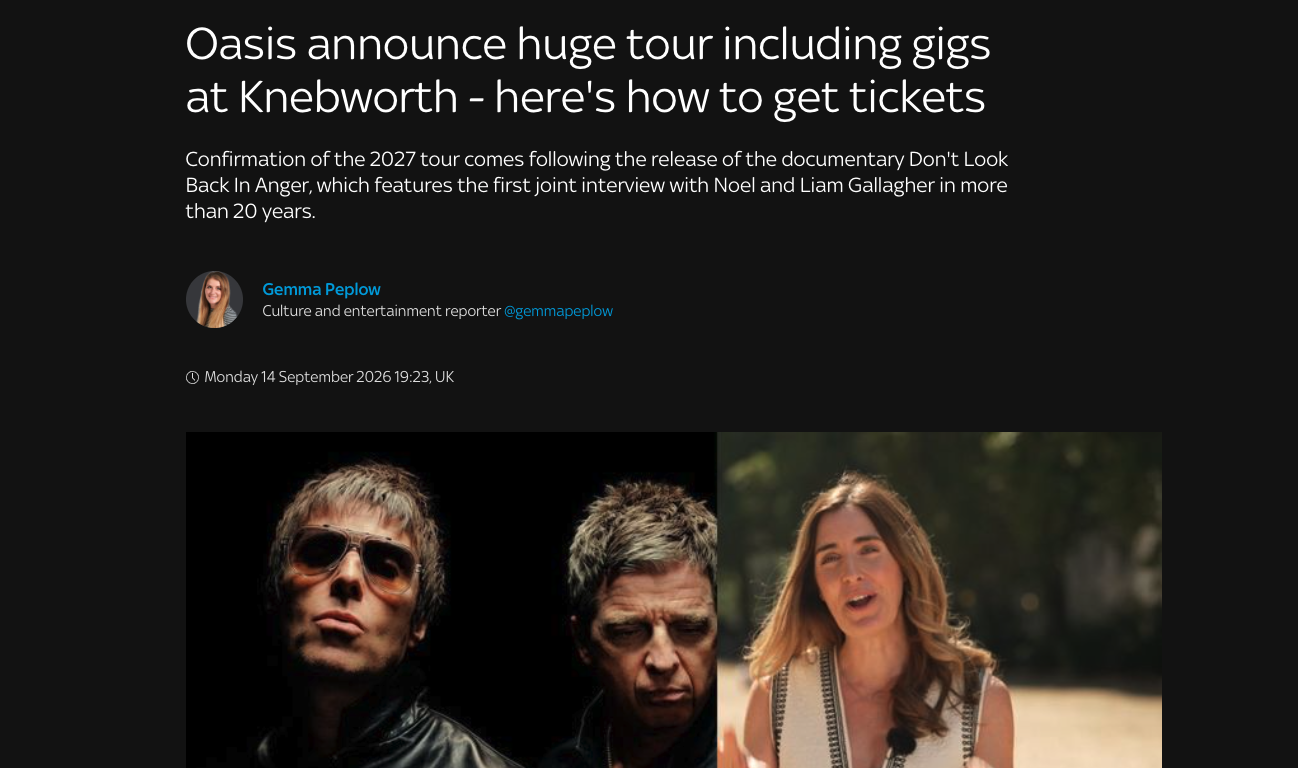
Oasis have just announced Oasis Live '27, a new run of dates across the UK, Europe and the US, closing with a return to Knebworth (you can see the announcement covered by Billboard). It's the biggest music story of the week, which makes it a perfect way to see the format in action on news you already know.
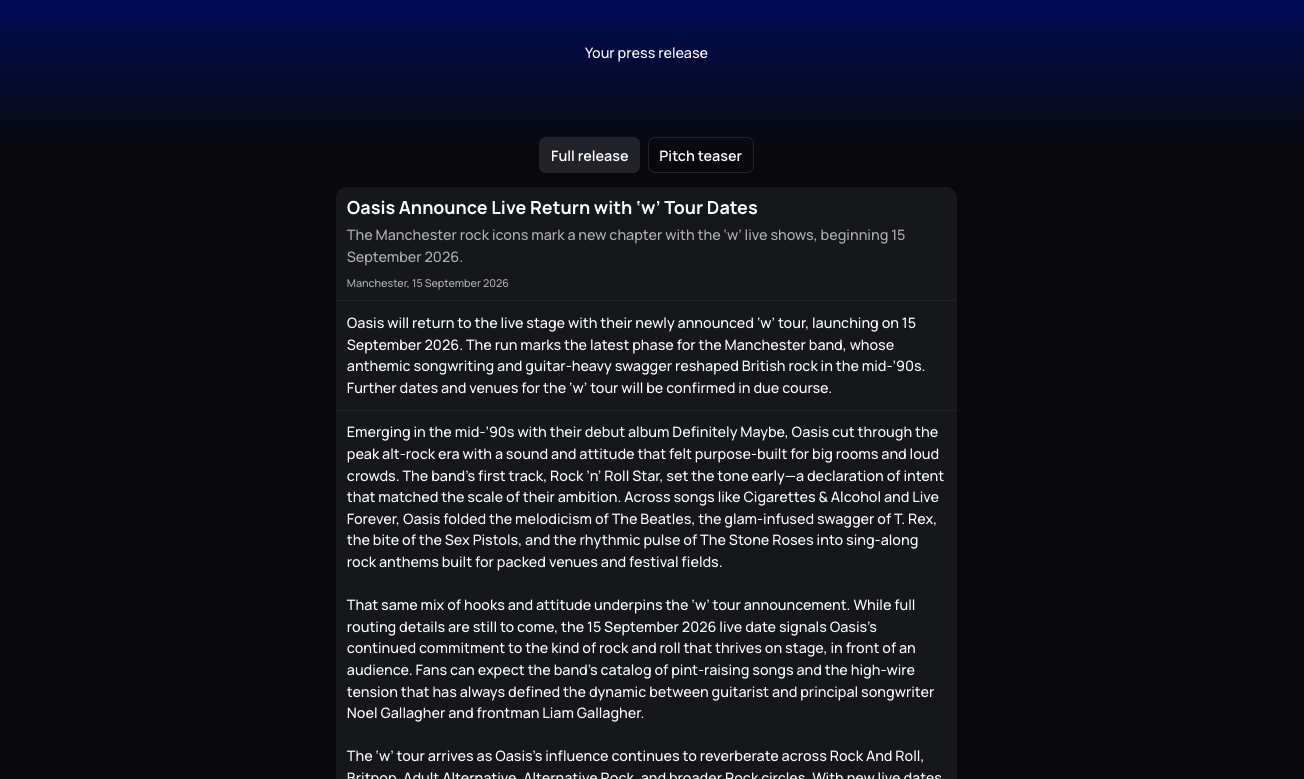
To show how quickly the structure comes together, we asked Lyra to draft a press release for the announcement. It produced the version below in under a minute.
One note before you copy it. The quote is an example Lyra generated to show where a quote sits and how it should read. It isn't a real statement from the band. In your own release, this is where you'd drop in a genuine quote from yourself or your team.
Here's the draft.
Oasis Announce Expanded 'Oasis Live '27' Tour Across UK, Europe and US
Following the success of their reunion shows, Oasis add new dates to Oasis Live '27, kicking off in Glasgow on 21 May 2027 and closing with four nights at Knebworth this September.
Manchester, 15 September 2026
Oasis have announced an expanded run of dates for Oasis Live '27, with the reunited band set to take their towering indie and rock anthems to fans across the UK, Ireland, mainland Europe and the US. The tour begins in Glasgow on 21 May 2027, before rolling through Manchester, Munich, Barcelona, Amsterdam, Paris, Rome, Boston, Las Vegas and Slane Castle (north of Dublin), and will culminate with four nights at Knebworth in September 2027.
The new shows follow the huge success of the initial Oasis reunion dates, which saw the band's catalogue of alternative, punk-tinged and singalong rock songs reconnect with audiences on a global scale. Responding to demand from fans, Oasis Live '27 now stretches across key cities and landmark venues, building on the momentum of their return to the stage and offering more chances to hear the songs that defined a generation.
"We've had an unbelievable response to the reunion shows, so it only made sense to get back out there and do more of it. Glasgow, Munich, Boston, Knebworth, the lot. We wanted to give people a few more nights to lose their voices with us."
About Oasis
Oasis are a Manchester-born band who broke onto the mid-'90s British rock scene with their 1994 debut, Definitely Maybe. Arriving at the peak of the alt-rock era, they offered a brash, melodic alternative, rolling the songcraft of The Beatles, the swagger of T. Rex, the sneer of the Sex Pistols and the grooves of The Stone Roses into pint-raising anthems like Cigarettes & Alcohol and Live Forever. Driven by the chemistry between guitarist-songwriter Noel Gallagher and singer Liam Gallagher, Oasis quickly became one of the defining rock groups of their generation.
Contact: press@[yourdomain].com | your website | your socials
Look at how each part earns its place. The headline tells the story in one line. The subheadline adds the hook (the first and last dates). The dateline sets the scene. Paragraph one is the full pitch, so a journalist could run it on that alone. Paragraph two brings the angle and the context. The quote reads like a person talking. The bio gives the background without rambling. Swap the band for your own name and the news for your own release, and you've got your music press release template.
How to write yours in minutes
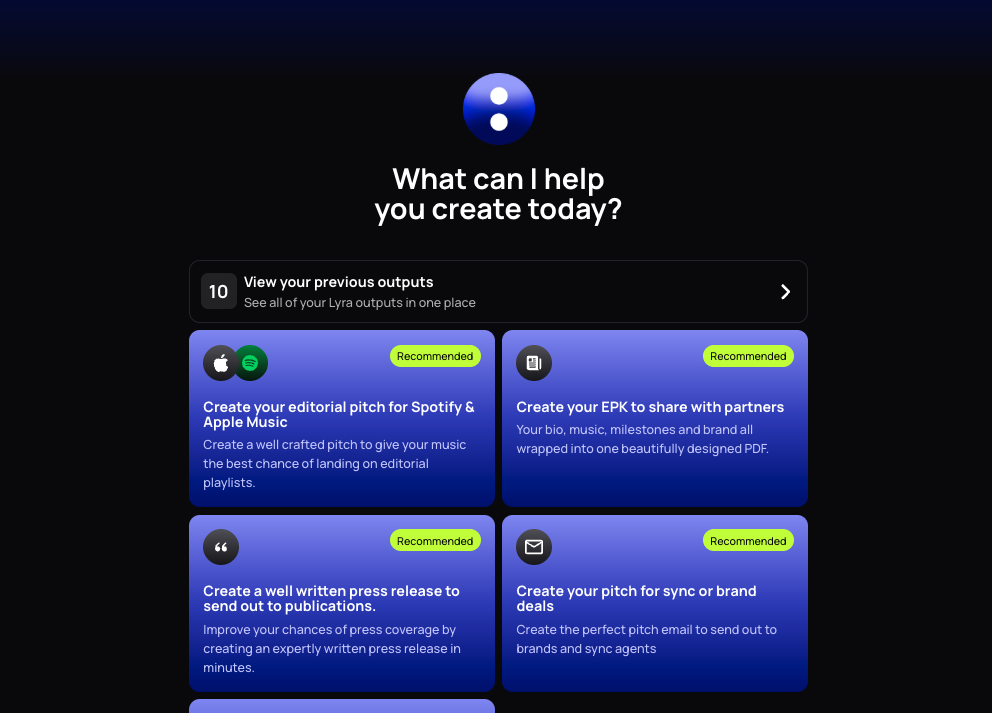
The blank page is the hardest part. Most independent artists don't stall because they can't write, they stall because they don't know the format and they're squeezing this in around a day job. That's where Lyra comes in.
Open Lyra inside the un:hurd app and it walks you through a few quick prompts, then drafts the whole thing in the right structure. You answer these:
- Choose the type of release you're announcing (single, EP, album, tour, video, milestone)
- The name of the release or tour
- The release or announcement date
- Your genre or genres
- A little about the story behind it (this is the bit that gives it an angle, so don't skip it)
- Any facts or highlights you want included (features, venues, numbers, collaborators)
- A headline, if you've already got one in mind, or leave it to Lyra
Fill those in and Lyra hands you a full first draft in the right format. From there it's a quick job to make it yours: your real quote, your voice, your links. You go from staring at nothing to a proper draft in the time it takes to make a coffee.
💬 Quick tip before you write a word: work out your angle first. Finish this sentence, "the story here is...". Something with more to it than "I'm releasing a single on Friday". Maybe the track came out of a rough year, maybe it's your first release with a live band, maybe it samples something nobody would expect. Journalists cover stories, so find yours before you start and the rest of the release falls into place.
Where to send it (without paying for coverage)
You'll see tools that promise to blast your release to hundreds of contacts for a fee. Skip them. A press release sent to 200 random inboxes gets ignored, and a lot of those "guaranteed placements" aren't worth having anyway.
Ten personalised emails to blogs, curators and writers who actually cover your genre will do far more than any paid blast. Build a real list of targets first (our guide to finding the right press targets shows you how), then personalise every email. Use the writer's name, mention something they've covered recently, and say in one line why your music fits what they write about. Send it, wait, and follow up once, politely.
The same instinct that makes a good playlist pitch makes a good press email. Make it about them, keep it short, and make the music one click away.
Ready to write yours?
Got something to announce? Open Lyra in the un:hurd app, tell it what you're releasing, and it'll draft your press release in the right format in minutes. Drop in your real quote and links, and you've got something ready to send.
👉 Draft your press release with Lyra
It's free for 7 days, so there's no reason not to have your next announcement ready to go.