How Many Fans Do You Actually Need to Make a Living From Music?
A $5bn music investor breaks down exactly how many fans independent artists need to sustain a career. The number is smaller than you think.

How Many Fans Do You Actually Need to Make a Living From Music?
Key Takeaways
- A $5bn music investor calculates that 100,000 loyal fans spending £80 ($100) per year on you equals £8 million ($10 million) in annual revenue
- You don't need millions of streams to build a sustainable music career. You need thousands of engaged fans who buy tickets, merch, and music directly
- The shift in the industry is away from chasing streaming numbers and towards building a loyal community you can monetise across multiple revenue streams
- Artists who keep their rights together (masters, publishing, neighboring rights) are in a significantly stronger financial position long-term
- Most independent artists are leaving roughly 20% of their potential income uncollected because they haven't registered for publishing, neighboring rights, or content ID
The number is smaller than you think
Most independent artists assume they need millions of streams to make a living. They don't.
On a recent episode of the find your frequency podcast, Matt Spetzler, a music investor who has closed over $5 billion worth of deals (including Kobalt Music Group and Native Instruments), broke down the actual maths of what a loyal fan base is worth.
His calculation is simple: if you have 100,000 fans and each of them spends roughly £80 ($100) on you per year (through a combination of streaming, live tickets, merch, and direct purchases), that's £8 million ($10 million) in annual revenue.
That's not a fantasy number. That's the economics of a mid-level independent artist with a genuinely engaged community.
And Matt's advice to artists? Stop chasing millions. Start finding thousands.
(Watch the full episode on YouTube or listen on Spotify)
Why streams alone won't build a career
The obsession with streaming numbers is understandable. Spotify playlists, monthly listener counts, and stream totals are the most visible metrics in an artist's career. But they're not the most valuable. (If you want to understand where playlist pitching fits into a broader strategy, we've written a full guide on that.)
Here's why: the average payout per stream on Spotify sits somewhere between £0.003 and £0.005. To earn £30,000 per year from streaming alone, you'd need somewhere in the region of 6 to 10 million streams annually. For an independent artist without a label's marketing budget, that's an enormous target.
Compare that to building a community of 5,000 genuinely engaged fans. If those fans each spend £60 per year on you (a couple of gig tickets, a t-shirt, maybe a vinyl), that's £300,000. With 5,000 people.
The difference is the relationship. Streams come from passive listeners who may never know your name. Revenue comes from fans who feel connected to you and your journey.
What does "engaged" actually mean?
It's worth being specific about what an engaged fan looks like, because this is where a lot of artists get it wrong.
An engaged fan isn't someone who follows you on Instagram. As presenter Josh Denzel (1M+ followers) pointed out on the same podcast series, social media platforms don't serve your content to all of your followers. The algorithm decides who sees what based on engagement signals like watch time, saves, and shares.
An engaged fan is someone who opens your emails, joins your WhatsApp group, buys a ticket when you announce a show in their city, and tells their mates about your music. They might only be one of 500 people, but they're worth more to your career than 50,000 passive followers.
Matt Spetzler put it this way on the podcast: the connectivity layer between artists and fans was historically controlled by labels and distributors. Today, with tools like WhatsApp, Discord, email, and direct-to-fan platforms, artists can own that relationship themselves. And if you have that direct connectivity, you can earn significantly more.
The money most artists don't know they're missing
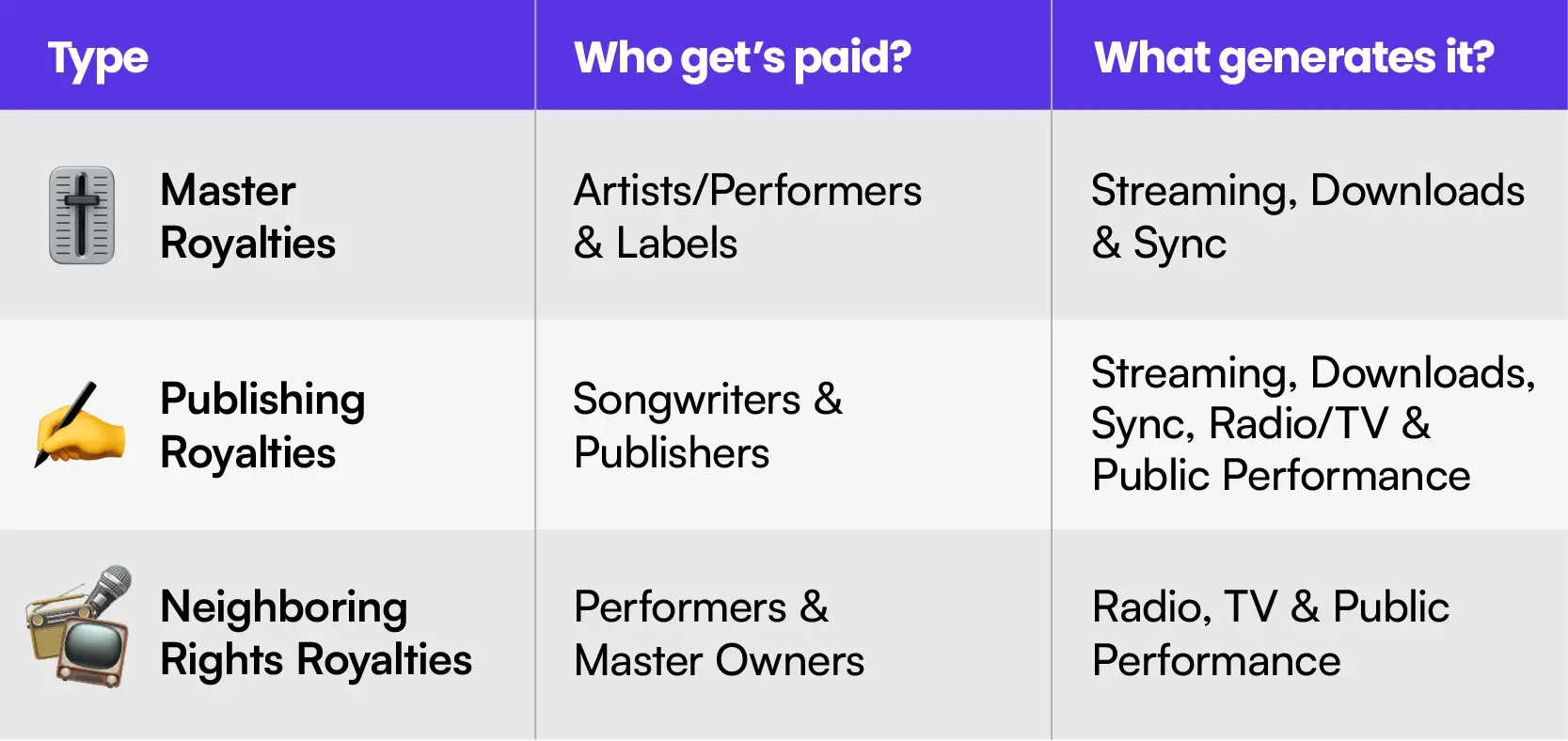
One of the most striking things Matt shared on the podcast was about uncollected income. He estimates that most independent artists are leaving roughly 20% of their potential earnings on the table simply because they haven't registered for all of the revenue streams available to them.
Here's where that money sits:
Publishing royalties are generated every time your song is played on streaming platforms, radio, TV, or in a public venue. If you wrote the song, you're entitled to publishing income on top of your master recording royalties. But you need to register with a collecting society (PRS for Music in the UK, or an equivalent in your territory) and ideally a publishing administrator. Many independent artists never do this.
Neighboring rights are separate from both master royalties and publishing. They're generated when your recorded music is played on radio or in public spaces. In the UK, PPL collects these. Again, you need to register. Many artists don't.
Content ID on YouTube means that when someone uses your music in their video (even a clip), you can earn revenue from it. Your distributor may handle this, but it's worth checking that it's actually switched on and collecting.
Matt's point was that these individual revenue streams might feel small, but they compound. "Collect all those pennies because they start to become pounds," he said.
Why you should keep your rights together
Another piece of advice from Matt that most artists won't hear elsewhere is about keeping your rights in one place.
The traditional music industry was built on splitting things up. Your masters go to a label. Your publishing goes to a publisher. Your neighboring rights go somewhere else. Each entity takes a cut and makes decisions independently.
Matt's view is that in today's world, especially with the rise of AI and sync licensing, there's enormous value in keeping everything together. When a brand wants to use your song in a commercial, the deal only happens if everyone agrees. If your masters are with one company, your publishing with another, and you've got five co-writers who all need to sign off, the opportunity often falls apart.
His advice: think of yourself as "artist inc." Work with your manager (or on your own) to monetise everything together. Merch, branding, social content, publishing, masters, neighboring rights. All under one roof. That gives you leverage and it gives you speed.
How to start building your fan base from zero
If you're reading this and thinking "great, but I don't have 100,000 fans, I have 47 monthly listeners," the path forward is simpler than you think.
Annabel Stop It, a DJ who now plays Tomorrowland, shared on episode 1 of the same podcast series that when she started building her audience from scratch, she focused on finding just 5 to 10 core supporters on one platform and growing from there. Those first few people became her community. They showed up to every stream, shared her content, and helped her grow organically.
The steps are practical:
Pick one platform where your potential audience already spends time. For some artists that's TikTok, for others it's YouTube, for others it might be Twitch or even Discord. Don't try to be everywhere. Focus.
Post consistently, showing not just your music but your process, your personality, and your journey. Fans connect with people, not just songs.
Bring your early supporters into a closer space. A WhatsApp group, an email list, a Discord server. Somewhere you own the relationship rather than renting it from an algorithm.
Build your release strategy around your community, not around streaming numbers. Plan each release as a campaign that deepens your connection with existing fans while reaching new ones.
Register for every revenue stream available to you: PRS (publishing), PPL (neighboring rights), content ID through your distributor, and any local equivalents in your territory. If you're unsure about what music promotion actually costs as an independent artist, that's worth understanding too so you can budget properly.
Keep your rights together wherever possible. The decisions you make at the start of your career about who owns what will have a massive impact 5 to 10 years from now.
The goal isn't fame. The goal is sustainability.
The most important reframe from Matt's conversation is this: the artists who build sustainable careers aren't the ones who go viral once. They're the ones who build a loyal community, however small, and serve that community consistently over years.
As Matt put it: if you become successful, your fan base coming back to listen to your music again and again is your most valuable asset. That's your retirement plan. That's your plan for you and your family.
The question isn't "how do I get a million streams?" The question is "how do I build a community that generates £30,000 this year so I can actually sustain a career?"
Start there. The rest follows.
This article is based on a conversation from the find your frequency podcast, where un:hurd music founder Alex Brees talks to artists, founders, and investors who've built something from nothing. Watch the full Matt Spetzler episode on YouTube or listen on Spotify.
.png)