How to get your music reviewed: Blogs, Feedback Platforms, and Tips
Learn where to get your music reviewed in 2026. Covers music blogs, feedback platforms like un:hurd, SubmitHub and Groover, plus tips to get accepted.
Getting your music reviewed by the right people can change the trajectory of a release. A well-placed blog feature gives you social proof to show bookers, labels, and new listeners. Honest feedback from a professional curator helps you understand how your music lands with fresh ears. And a playlist placement from a review platform can push your Spotify streams and engagement in ways that organic social posting alone rarely matches.
But here's the thing most guides won't tell you: where you submit matters far more than how many places you submit to. Blasting your track to 50 random blogs is a waste of time. Getting it in front of five people who genuinely cover your sound is worth ten times more.
This guide breaks down exactly where to get your music reviewed in 2026, from free blog submissions to paid feedback platforms, and then walks you through how to actually get accepted.
Why Getting Your Music Reviewed Still Matters in 2026
You might think blog reviews are outdated media of the 2010s. Social media, playlists, and short-form video dominate discovery now. So why bother?
Because reviews do something that a 15-second TikTok clip can't: they build a story around your music. A thoughtful review gives you something to share with bookers, include in your EPK, and reference when pitching to bigger outlets. It's third-party validation that you didn't write yourself, and that carries weight.
Professional feedback from curator platforms is equally valuable, even when your track gets declined. Knowing that your production quality needs tightening or that your track doesn't match a playlist's mood is specific, actionable information you can use on your next release. It's a world apart from posting on socials and hearing nothing but silence.
And for independent artists who are building their career release by release, stacking up blog features and playlist placements creates a trail of credibility. Each one makes the next pitch easier.
Music Blogs That Accept Submissions From Independent Artists
There are hundreds of music blogs out there, but only a fraction are actively accepting submissions from unsigned or independent artists. Here are some worth knowing about.
Established outlets with open submissions:
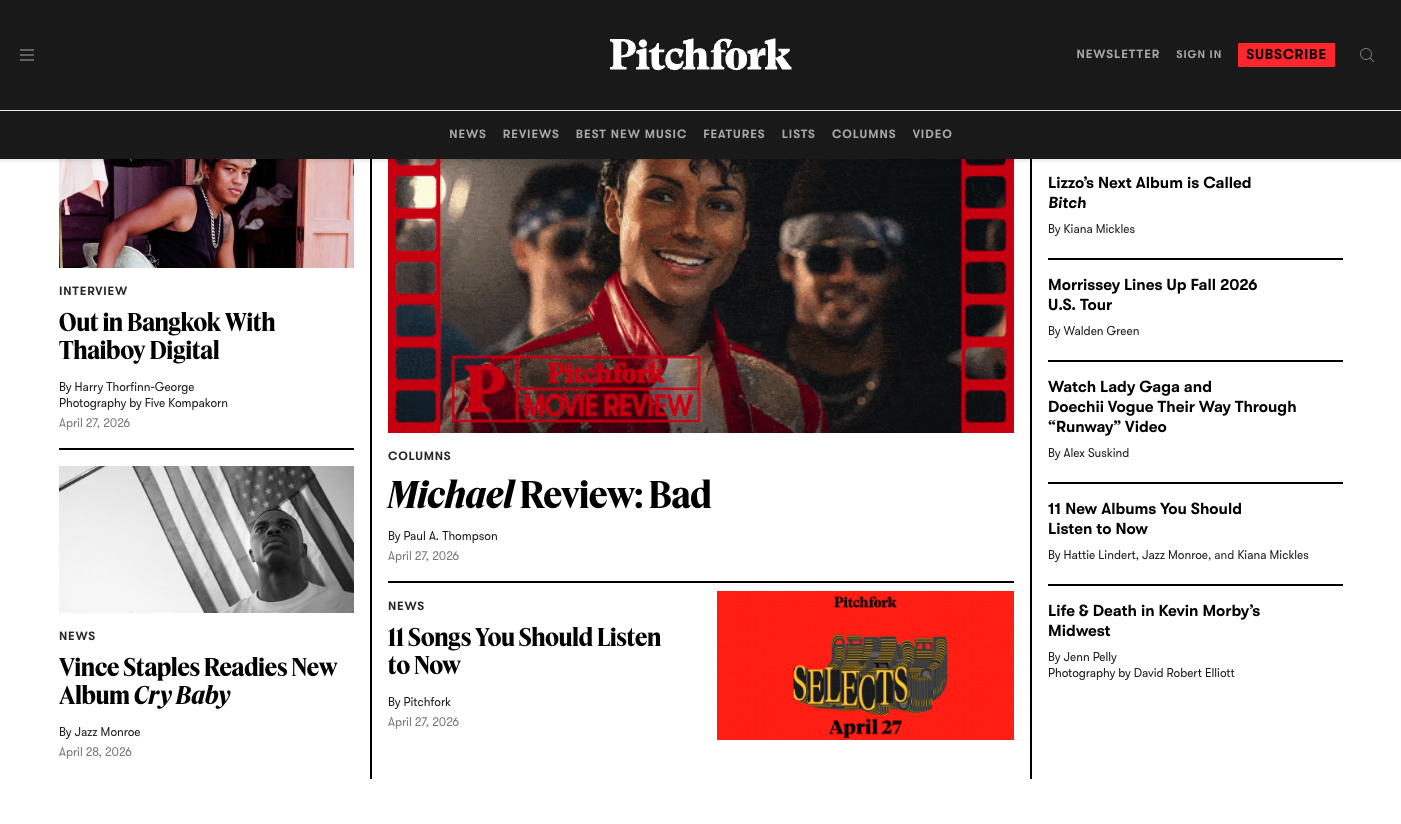
- Pitchfork covers a wide range of genres and has a submission form on their contact page, though they lean towards artists with existing momentum. Getting featured here is a serious credibility boost, but it's competitive.
- Consequence of Sound accepts submissions across genres and has a large, engaged readership.
- American Songwriter explores all genres and has 1.5 million monthly website visitors. A feature here can meaningfully shift your visibility.
- Bandcamp Daily features artists on the Bandcamp platform. If you have an active Bandcamp page, you're eligible.
Indie-focused blogs actively seeking new music:
- A&R Factory has a global readership that includes label owners, publishers, radio stations, and sync licensing firms. It's a good outlet if you want your review seen by industry, not just fans.
- HighClouds is a Brussels-based blog dedicated to indie and alternative pop. Great for emerging artists in those lanes.
- RGM specialises in honest artist feedback and reviews, producing original content daily. They actively want to work with artists on their next release.
- The Pit London is ideal for home-grown, independent music, started by genuine music enthusiasts who share a passion for discovering new sounds.
- EKM.CO has been spotlighting emerging electronic artists since 2009, with in-depth reviews and artist interviews.
Many of these blogs also accept submissions through SubmitHub, which we'll cover in the next section.
How to Find the Right Blog for Your Sound
The blog landscape is enormous, so narrowing it down is essential. Start with these approaches:
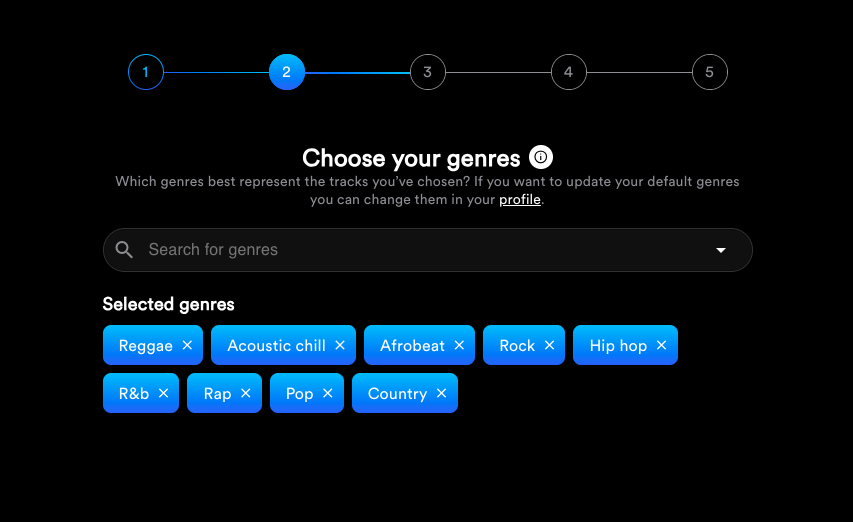
Search by genre. If you make lo-fi hip hop, search for "lo-fi hip hop blog submissions" or browse un:hurd's genre filters. Don't waste time pitching outlets that never cover your style of music.
Check who covers artists similar to you. Look at artists in your genre who are a step or two ahead of you. Where have they been featured? Those outlets are likely open to music at your level too.
Read before you submit. This sounds obvious, but most artists skip it. Spend 10 minutes on a blog before you email them. Read their most recent reviews. If they haven't posted in three months, they're probably not actively reviewing. If their last five features are singer-songwriter acoustic tracks and you make drum and bass, move on.
Feedback Platforms That Guarantee Your Music Gets Heard
Free blog submissions are great, but the response rate can be low. You're competing with hundreds of other artists in an editor's inbox, and there's no guarantee your track ever gets played.
Paid feedback platforms solve this by guaranteeing that a real person listens to your music and responds. The trade-off is cost, but for many independent artists, the certainty of professional feedback (and the chance of a placement) is worth it.
Here's how the main platforms compare.
un:hurd
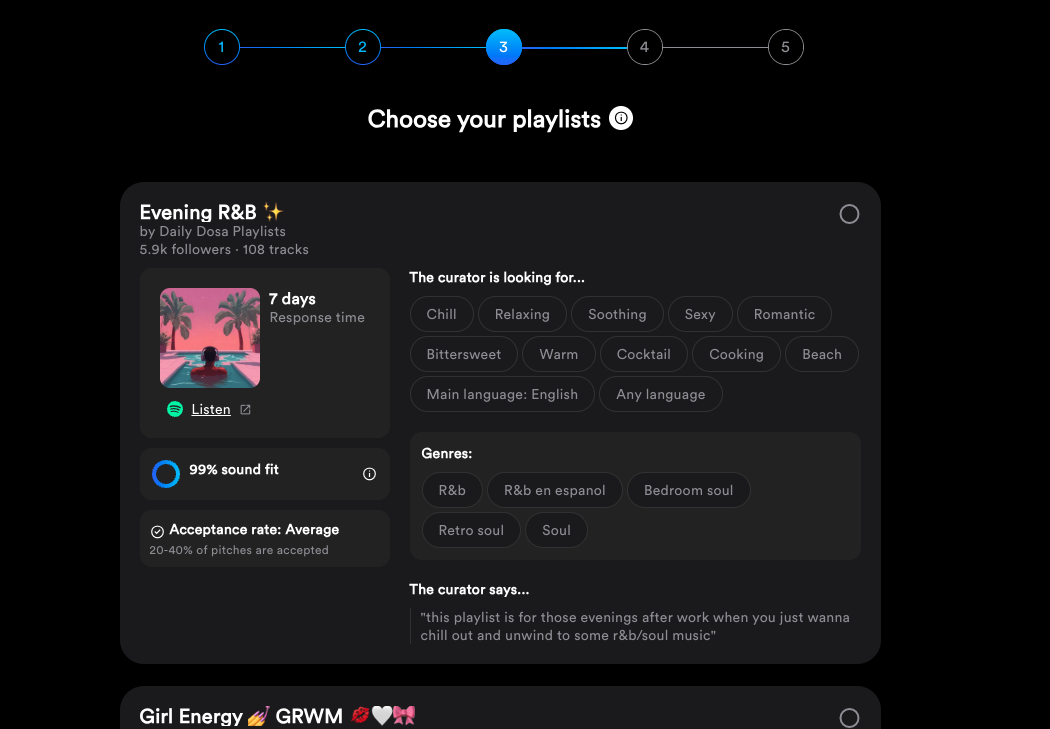
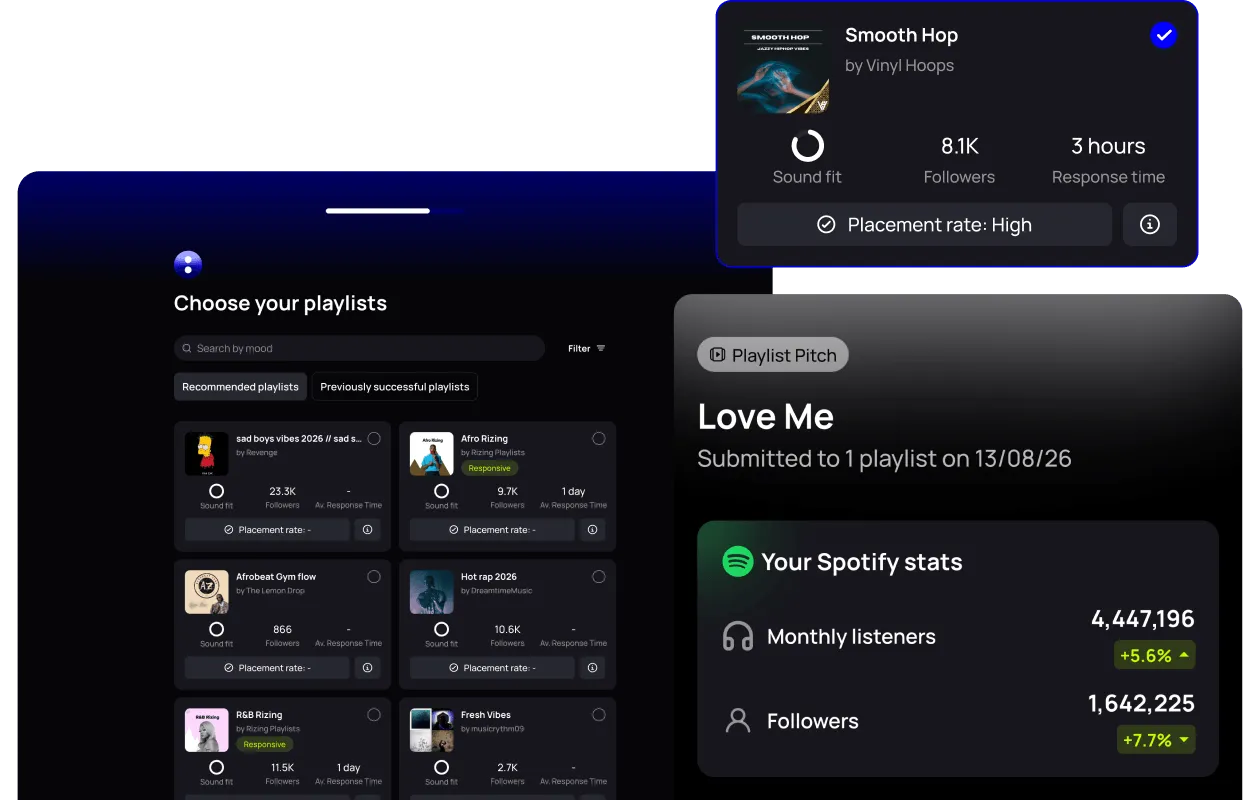
un:hurd's playlist pitching works differently from most submission platforms. When you pitch through un:hurd, your track goes to curators who are matched to your sound based on listener overlap, not just genre tags. That means you're reaching curators whose existing audience already listens to music like yours.
The network includes 533 curators across 3,499 playlists, and over 23,000 songs have been placed through the platform so far. The average acceptance rate sits at 45%, which is dramatically higher than what you'll find on SubmitHub or most other platforms. It's because the matching algorithm does the heavy lifting upfront, so your track is only going to curators where it genuinely fits.
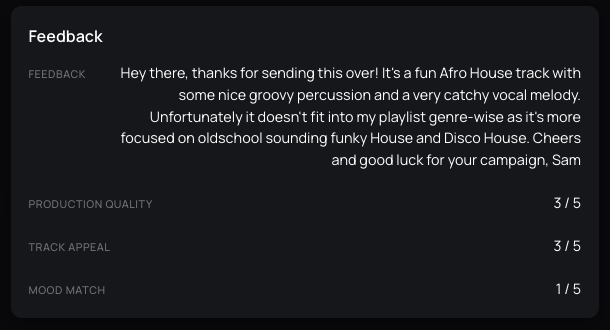
Every curator listens for at least 30 seconds and reviews your track across three specific criteria:
- Production Quality: Has the track been mixed and mastered to a professional standard? Do all the musical elements work well together?
- Track Appeal: Does the song appeal to its intended audience, and does it have strong repeat-play value?
- Playlist Mood Match: Does the song fit the vibe and emotion of the playlist? Genre alone isn't enough. Curators consider mood and feel.
This structured review process means you get genuinely useful feedback, not just a "yes" or "no." You'll understand exactly where your track landed well and where it fell short.
When a curator accepts your pitch, your track gets placed directly onto their playlist, which boosts your Spotify streams and engagement organically. These are real playlists with real listeners, matched to your sound through data, not pay-to-play schemes.
To put some real numbers on it: un:hurd artist Jaylon pitched 7 songs to 47 targeted playlists through the platform. Over three months, his monthly listeners jumped 43% to over 80,000, his Spotify engagement score more than doubled (from 16 to 37), and editorial playlisting extended his reach to over 147,000 new listeners. That's what happens when your music lands in front of the right curators, not random ones.
Pitching starts at £6 per pitch, making it one of the most affordable routes to professional feedback and genuine playlist placement. With over 200,000 artists on the platform, it's also one of the largest independent artist communities in the space.
SubmitHub
SubmitHub is the most established submission platform, connecting artists to over 6,000 curators including playlist curators, music bloggers, YouTube channels, and influencers. The platform uses a credit system at roughly $1-3 per submission, and curators must respond within 48 hours.
The strength of SubmitHub is its sheer volume and variety. You can target blogs, playlists, YouTube channels, and TikTok influencers all from one platform.
The downside? With 4.5 million submissions per year hitting those 6,000 curators, the acceptance rate sits around 5-8%. Feedback quality varies significantly. Some curators give thoughtful, specific notes. Others send a one-line template rejection. And because responses are required within 48 hours (compared to un:hurd's more considered approach), many responses feel rushed.
SubmitHub works best when you spend serious time researching each curator before submitting. Treat it like a sniper rifle, not a shotgun.
Groover
Groover launched in Paris in 2018 and has built a strong European curator network. Each submission costs €2 (roughly £1.70), and curators have 7 days to respond. If they don't reply, you get your credits back.
Groover's strength is its international reach, particularly across France, Germany, the Netherlands, Spain, and the UK. Artists consistently report that feedback on Groover tends to be more detailed and constructive than on some other platforms. The platform also includes access to A&R representatives at independent labels, which is unusual in this space.
The curator base is smaller than SubmitHub's, and finding playlists that match your specific sound can take time. Budget at least €20-30 per campaign to get meaningful data.
HAT Music
HAT Music takes a different approach entirely. Rather than just pitching to playlists, it's a platform where artists connect directly with vetted music professionals: managers, A&R reps, producers, sound engineers, booking agents, and more.
With over 10,000 downloads and 5,000 verified professionals on the platform, HAT Music is particularly useful if you want feedback and connections that go beyond playlist placement. Their Pitch Room feature lets industry experts listen to your tracks and give direct feedback.
HAT Music is an un:hurd partner, and all un:hurd members get one free month of HAT Music Pro. So if you're already using un:hurd for your release planning and playlist pitching, you can connect with producers, engineers, and other professionals to collaborate on your next project at no extra cost. It's a natural next step if you've received feedback through un:hurd's curator reviews and want professional help acting on it.
How to Get Better Reviews (and More Acceptances)
Submitting your music is the easy part. Getting accepted is where most artists struggle. These tips will significantly improve your hit rate.
Do Your Homework Before You Hit Submit
This is the single most impactful thing you can do, and almost nobody does it properly.
Listen to the playlist before you pitch to it. Don't just glance at the name and genre tag. Actually press play. Listen to 5-10 tracks. Ask yourself honestly: does my song belong alongside these? If you make aggressive trap and the playlist is full of mellow lo-fi beats, the genre tag might say "hip hop" for both, but the mood is completely different. A curator will spot this mismatch in seconds and decline without a second thought.
Even on un:hurd, where the matching algorithm does a strong job of pairing you with relevant playlists, curators still cite mood mismatch as one of the most common reasons for declining a track. The algorithm gets you in the right neighbourhood, but you still need to check that your track fits the specific playlist. Five minutes of listening before you submit can be the difference between a placement and a pass.
The other major reason curators decline? Production quality. If your mix isn't tight or your master sounds flat compared to the other tracks on a playlist, curators will hear it immediately. This is worth knowing before you submit anywhere, because it's something you can fix.
Read the blog before you email them. Look at their last 5-10 posts. What kind of artists are they featuring? What's their tone? Do they write long-form reviews or short blurbs? Are they actively posting, or has the blog gone quiet? This tells you whether your submission will actually be read, and it gives you context to write a much better pitch.
Check the curator's profile and stats. On platforms like SubmitHub and un:hurd, you can see what genres a curator covers, what their acceptance rate looks like, and sometimes what they've recently added. Use this information. A curator who has added three indie folk tracks this week is more likely to be receptive to your indie folk single than someone who added three electronic tracks.
Spending 5 minutes researching before you submit will save you money and dramatically increase your acceptance rate. Most artists skip this step entirely, which is exactly why their acceptance rate is low.
Target the Right Blogs and Playlists for Your Fan Persona
Think about who your ideal listener is. Not in vague terms like "people who like good music," but specifically. What other artists do they listen to? What playlists are they already following? What blogs would they read?
Now work backwards. If your ideal listener follows playlists full of dark, moody R&B, that's where your music should be pitched. If they read blogs that cover underground electronic music, those are the blogs to approach.
A rap song doesn't belong on a pop playlist. An acoustic folk track doesn't belong on an EDM blog. This sounds painfully obvious, but the majority of rejections on every platform come down to simple genre and mood mismatch.
un:hurd's matching algorithm handles this automatically by pairing your music with curators based on listener overlap data. But when you're submitting to blogs or using other platforms, you need to do this filtering yourself.
Include Everything a Reviewer Needs
When a blogger or curator is considering your track, they often need more than just a streaming link. Making their job easier increases your chances of getting featured.
Build a basic EPK (Electronic Press Kit) that includes:
- A short, compelling bio (150-200 words, not your life story)
- 2-3 high-quality press photos (not selfies, not blurry phone shots)
- Links to your streaming profiles (Spotify, Apple Music, etc.)
- Links to your social media
- A one-paragraph description of the track you're submitting (what inspired it, who it's for, what it sounds like)
- Any previous press coverage or notable playlist placements
For blog submissions specifically, also include:
- A downloadable press photo they can use in their article
- An embeddable link (Spotify, SoundCloud, or YouTube)
- Your release date if the track isn't out yet
Groover actually does this well on their platform. When a curator needs supporting material, it prompts you to upload it, and then automatically supplies it to other curators who need the same files.
The point is: don't make a reviewer chase you for basic information. Have it ready before you submit.
Time Your Submissions Around Your Release
Timing matters more than most artists realise.
For blog submissions: Reach out 2-4 weeks before your release date. Bloggers need time to listen, write, and schedule their post. If you email them on release day, you're already too late for a proper feature.
For playlist pitching: Submit as early as your track is ready. On un:hurd, you can pitch upcoming releases so curators can review them ahead of your release date. Spotify's own editorial pitching tool asks for at least 7 days' notice, and more is better.
For feedback platforms: If you're looking for feedback you can actually act on (mixing notes, production suggestions), submit before you've finalised the master. If you're looking for placement and coverage, submit once the track is polished and ready.
Building this into your release timeline is exactly what un:hurd's Release Cycles feature is designed for. It maps out your entire 8-week release plan, including when to pitch for reviews and playlist placements, so nothing gets left to the last minute.
Write a Pitch That Doesn't Sound Like a Template
Every blogger and curator has seen the same pitch a thousand times: "Hey, I'm an independent artist from [city] and I'd love for you to check out my new single. I think it would be a great fit for your blog/playlist."
That tells them nothing. Here's what a better pitch includes:
- Why them specifically. Mention something about their blog or playlist that shows you've actually engaged with it. "I saw you featured [artist name] last month, and my track sits in a similar space" is infinitely better than "I think this would be a great fit."
- What the track sounds like, concretely. Don't say "it's a vibe." Say "it's a slow-building electronic track with chopped vocal samples over minimal percussion, somewhere between James Blake and Burial."
- One sentence on why now. Is it a debut single? Part of an upcoming EP? A collaboration with someone they might know? Give them a hook for their story.
Keep it short. Three to four sentences maximum. Curators are scanning dozens of pitches. Respect their time.
What to Do With Your Reviews Once You Get Them
Getting reviewed is only half the value. What you do with those reviews afterwards matters just as much.
Add positive reviews to your EPK. A quote from a respected blog or curator is social proof you can use in every future pitch. Pull the best line and include it alongside your bio and press shots.
Share reviews on your socials. A blog feature isn't just for the blog's audience. Screenshot the review, share it on your Instagram stories, post it to your feed. Tag the blog. This builds the relationship and makes them more likely to cover your next release.
Learn from constructive feedback. If a curator rated your production quality low, that's information you can use before your next release. If multiple curators say the mood doesn't match what you pitched to, that tells you to rethink your targeting, not your music.
Use reviews to build your content strategy. Every review is a piece of content. A blog feature becomes a social post. Curator feedback becomes a "behind the scenes" story about how you're developing your sound. This kind of content resonates with fans who want to follow your journey, not just hear the finished product.
Start Getting Your Music in Front of the Right People
If you're planning a release in the next few weeks, don't leave reviews and feedback to chance. Join 200,000+ artists already on un:hurd and set up a Release Cycle to map out your full release plan, including when to pitch for playlists and reviews. Then use un:hurd's playlist pitching to get your track in front of 533 curators across 3,499 playlists, matched to your sound, with structured feedback on production quality, track appeal, and playlist mood match.
Your music deserves more than a cold email into someone's spam folder. Put it in front of people who are actually looking for it.